
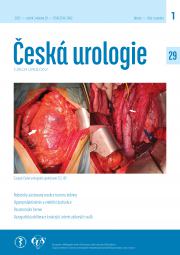

Czech urology, 2000 (vol. 4), issue 2
Management of acute post ESWL complications
Geert G. Tailly
Ces Urol 2000, 4(2):5-8 | DOI: 10.48095/cccu2000006 
The strategy and management in treatment of postoperative bleeding following the retrograde endopyelotomy
O. Kőhler, P. Fencl
Ces Urol 2000, 4(2):9-14 | DOI: 10.48095/cccu2000007
In the time period from 1995 till 1999 underwent 41 patients with obstructed pyeloureteral junction (30 cases of primary and 11 cases of secondary obstruction) the operation by technique of retrograde endopyelotomy. Two cases (4,9 %) of severe clinical bleeding requiring blood transfusions occurred.In one female from those patients surgeons succeeded in angiographic detection of bleeding source from auxiliary polar artery crossing the pyeloureteral junction and they stopped the bleeding after use of the superselective embolisation. But the hemorrhage reoccurred after 14 days. The repeated embolisation has closed the auxiliary polar artery and thereafter...
The urolithiasis occurrence in continent neovesica
Petr Morávek, Petr Prošvic, Abdulbaset Hafuda
Ces Urol 2000, 4(2):15-19 | DOI: 10.48095/cccu2000008
Authors followed the group of 52 patients (49 males and 3 females) with continent neovesica, they analyzed the occurrence of lithiasis and its reasons, composition and ways of treatment. Lithiasis occurred in 6 males (11,5 %) with continent orthotopic derivation. The average period of stone formation was 25 months. In lithiasis development participated the larger amount of residual urine (above 150 ml) in all patients, and the significant urinary infection in 4 cases (3 cases of Proteus sp., and 1 with Enterobacter sp.). Struvite was identified in five patients (once pure, in three cases combined with apatite and once with urate) and the last concrement...
The prognostic significance of imunohistochemical evaluation of p53 in tissue of superficial urinary bladder tumors
M. Babjuk, J. Dušková, J. Dvořáček, C. Povýšil, Z. Ibrahim, L. Jarolím, J. Novák
Ces Urol 2000, 4(2):20-26 | DOI: 10.48095/cccu2000009
The assessment of prognostic factors plays important role in treatment preference chosen for patients with superficial urinary bladder tumors. The role of gene and protein p53 is often discussed in those circumstances. In stored specimens from 55 patients with superficial tumors of the urinary bladder we have investigated the p53 (antibody BP53-12-1) by imunohistochemic technique and we have evaluated the prognostic value of such statement. Newly we used a new method of finding's interpretation, based on a semiquantitative assessment by HSCORE using the computer technologies combined with the intensity of every individual cellular nuclei positivity....
The malignant potential of chromophobe renal cell carcinoma
M. Hora, Z. Ouda, M. Roušarová, O. Hes, M. Michal
Ces Urol 2000, 4(2):27-29 | DOI: 10.48095/cccu2000010
Chromophobe renal cell carcinoma (ChRCC) has a relatively low malignant potential according to literature. Recently some studies have appeared indicating that the sarcomatous form of renal carcinoma develops most frequently from ChRCC, also the higher malignancy is reported in larger size tumors or in tumors mixed with clear cell carcinoma and in coexistence with renal papilocarcinoma.The number of 5 patients (representing 1,72 percentage from the total number of 233 patients with surgery of renal tumor) underwent a surgical procedure for ChRCC at the Urology Department of the Faculty Hospital in Plzeň during the time period from 1994 - 3/1999....
Renal oncocytoma - tumor of unambiguous benignity
M. Hora, Z. Ouda, O. Hes, M. Michal, M. Roušarová
Ces Urol 2000, 4(2):30-32 | DOI: 10.48095/cccu2000011
Renal oncocytoma (M8290/1) represents about 5 % of all renal tumors. Former literature repetitively mentioned the possibility of its malignant development. The update knowledge document that so called metastatic oncocytomas were probably chromophobe renal cell carcinomas or granular forms of clear cell renal carcinoma with incorrect histology classification. The correct histology diagnosis has the crucial significance.In the time period from 1992 to 3/1999 the number of 15 patients underwent surgery for oncocytoma at the Urology Department of the Faculty Hospital in Plzeň (representing 4,82 % from the total number of 311 renal tumor operations)....
The primary reconstruction of urinary bladder extrophy in girls with use of paraextrophic dermal flaps
P. Zerhau, B. Hnilička
Ces Urol 2000, 4(2):34-39 | DOI: 10.48095/cccu2000012
The surgical treatment of urinary bladder extrophy represents one of the most difficult operative procedures in pediatrie urology. The enlargement of urethra using paraextrophic flaps in time of the primary reconstruction allows the insertion of urinary bladder into the small pelvis, increases the chance of continence status in the future age and improves outcomes of eventual bladder neck reconstruction. First three patients underwent the described surgery. Two of them recovered primary with good cosmetic and also functional outcome, the resurgery was needed in one patient, and the urethral dilatation in one case. The urinary bladder capacity in pressure...
Antegrade sclerotherapy testicular vein in patients with sinistral varicocele
P. Hanek, R. Pádr, I. Kawaciuk, V. Janík, J. Černý
Ces Urol 2000, 4(2):40-42 | DOI: 10.48095/cccu2000013
In the Urology Department of Faculty Hospital Prague - Motol there had been indicated 20 patients to treatment of varicocele by sclerotisation testicular vein throw the way plexus pampiniformis. This method has been shown technical effective in 19 patients (95 %). In none patient have been found persistent or recidivant varicocele. This method as minimal invasive is possible to practice by local anaesthesia and only one day in hospital. That mean it is high effective, reliable and safe method. Seminal analysis was performed before and 6 to 24 months after sclerotherapy. Seminal analysis showed a significant improvement of pathologic levels in 11 from...
Verrucous carcinoma of the penis - rare variant of squammous cell carcinoma
H. Schneider, *L. Sokol, L. Valanský, M. Bača, V. Nagy
Ces Urol 2000, 4(2):43-46 | DOI: 10.48095/cccu2000014
Verrucous carcinoma of the penis is uncommon variant of squamous cell carcinoma of the penis. During the last fifteen years authors have seen just one case of it. Because of its unique histomorphologic characteristic and behavioral peculiarities they have decided to remind this relatively rare clinico-pathologic entity. In the article they deal with its place in the spectrum of squamous proliferations of the anogenital region, still controversial relation of verrucous carcinoma of the penis to gigantic condyloma of Buschke-Löwenstein, clinical strangeness and possibilities of the diagnosis and therapy.
TNM klasifikace zhoubných nádorů, 5. revize z roku 1997
M. Hanuš, M. Matoušková
Ces Urol 2000, 4(2):47 | DOI: 10.48095/cccu2000015