
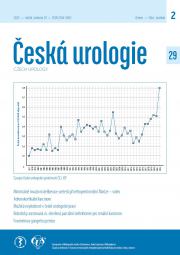
Czech urology, 2025 (vol. 29), issue 2
Editorial
Editorial
Antonín Brisuda
Ces Urol 2025, 29(2):65-66 
Video
Minimally invasive ureterolysis in retroperitoneal fibrosis (Ormond´s disease) – video
Milan Hora, Olga Dolejšová, Petr Stránský Jr., Dominika Šiková, David Suchý, Jiří Ferda
Ces Urol 2025, 29(2):67-68 | DOI: 10.48095/cccu2025009
Introduction: In idiopathic retroperitoneal fibrosis, ureteral involvement of the retroperitoneal fibrotic mass (especially in the middle part of the ureters) dominates, leading to the development of (dolicho-) megaureters with subsequent progressive renal insufficiency. The left side tends to be affected earlier. The solution is to influence the etiopathogenesis of the disease (especially corticoid treatment) and diversion of the upper urinary tract. Either permanent stenting of both ureters with all its disadvantages or ureterolysis. Historically open via midline laparotomy, more recently minimally invasive. In this paper we evaluate the results...
Review article
Adrenocortical carcinoma – a review of current knowledge for Czech urological practice
Marek Broul, Aneta Hujová, Michaela Liegertová, Lucie Radovnická
Ces Urol 2025, 29(2):69-75 | DOI: 10.48095/cccu2025012
Adrenocortical carcinoma (ACC) is a rare but highly aggressive malignancy of the adrenal cortex, accounting for less than 0.2% of all solid tumors. Despite its low incidence, ACC is associated with significant morbidity and mortality and requires a multidisciplinary diagnostic and therapeutic approach. This review summarizes current knowledge of the epidemiology, etiology, diagnostics, staging, treatment strategies, and follow-up of ACC, with an emphasis on the specifics of Czech clinical urological practice. Special attention is paid to the integration of hormonal diagnostics, imaging modalities (including advanced PET/MR and novel tracers), and genetic...
Non-invasive urinary biomarkers in the diagnosis and monitoring of bladder cancer
Barbora Žemličková, Antonín Brisuda
Ces Urol 2025, 29(2):76-85 | DOI: 10.48095/cccu2025011
Major statement: Non-invasive urinary biomarkers represent a promising alternative to cur- rent diagnostic methods for bladder cancer. This study aims to present the main available biomarkers, evaluate their benefits, and assess their potential use in diagnosis and patient monitoring.Summary: Bladder tumors are a common disease worldwide. They are often recurrent tumors requiring long-term monitoring, making them highly prevalent. The primary diagnostic method is cystoscopy, which is also essential for follow-up. In both cases - diagnosis and surveillance - an invasive method is used, carrying a significant risk of complications....
Male infertility in Czech urological practice – current diagnostic and therapeutic trends
Marek Broul, Aneta Hujová, Michaela Liegertová
Ces Urol 2025, 29(2):86-93 | DOI: 10.48095/cccu2025014
Male infertility is a multifactorial condition contributing to approximately 50% of all cases of couple infertility. In recent years, significant advances have been made in both diagnostics and treatment. This review summarizes key developments from 2019 to 2024 with direct relevance to routine clinical practice in Czech urology and andrology. Particular attention is paid to the updated semen analysis standards (World Health Organisation 6th edition, 2021), sperm DNA fragmentation testing, genetic evaluation (karyotyping, Y chromosome microdeletions, and exome sequencing), surgical management of varicocele, and sperm retrieval techniques...
Original paper
Robot-assisted vs. open partial nephrectomy for renal cell carcinoma – functional and oncological outcomes according to RENAL nephrometric score
Veronika Lounová, Vladimír Študent Jr.
Ces Urol 2025, 29(2):94-102 | DOI: 10.48095/cccu2025015
Major statement: Partial nephrectomy is currently the standard treatment for cT1 renal tumors. Although the robotic approach (RAPN) does not clearly demonstrate superiority over open surgery (OPN), it has gained popularity. This study aims to compare the perioperative, functional, and oncological outcomes of these modalities. Summary: Objective: The study aims to compare the perioperative outcomes of robot-assisted partial nephrectomy (RAPN) and open partial nephrectomy (OPN), assessed according to tumor complexity using the RENAL nephrometric score. Patients and methods: The retrospective study included patients...
Case report
Fournier´s gangrene of the penis - reconstruction using full-thickness skin graft
Martina Korčáková, Patrik Richtr, Tomáš Vavřík, Petr Běhounek
Ces Urol 2025, 29(2):103-107 | DOI: 10.48095/cccu2025010
In this case report, we present the management of a patient with fulminant Fournier´s gangrene of the external genitalia in a septic state with the development of multiple organ failure and the need for admission to the anaesthesiology and intensive care unit. Early initiation of treatment and interdisciplinary cooperation led to the management of the patient´s critical condition. The extensive penile skin defect was successfully completely healed with a full-thickness skin graft with good functional and aesthetic results, thus preserving the patient´s good quality of life.
Information
Zpráva z 36. setkání Pediatrické sekce České urologické společnosti ČLS JEP
Pavel Zerhau
Ces Urol 2025, 29(2):115-116
Od urologie ke koalám – jak jsem se dostala díky programu EUREP až na rezidentský týden v Austrálii
Barbora Žemličková
Ces Urol 2025, 29(2):117-118
Drug profile
Innovative pharmacological form of treatment for erectile dysfunction – sildenafil in an orally dissolvable film
Marek Broul
Ces Urol 2025, 29(2):109-113 | DOI: 10.48095/cccu2025013
Introduction: Erectile dysfunction (ED) is a highly prevalent disorder that significantly affects the quality of life of men and their partners. Phosphodiesterase type 5 inhibitors (PDE5i), particularly sildenafil, form the first line of pharmacological treatment for ED. However, the traditional tablet form may be associated with a slower onset of action, a higher incidence of adverse effects, and reduced adherence in some patients. An innovative drug form – an orally dissolvable film (ORF) containing sildenafil – has been developed to overcome these limitations. Methodology: The article summarizes the available clinical and...