
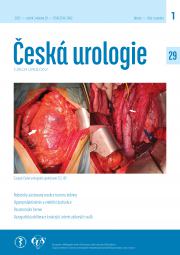

Czech urology, 2001 (vol. 5), issue 1
The rare case of self-mutilation of genitals
A. Čermák, D. Pacík, T. Hanák, J. Kladenský, I. Peška
Ces Urol 2001, 5(1):4-8 | DOI: 10.48095/cccu2001001 
The self-inflicted trauma of penis including its total amputation with scrotal amputation together with testes represents a rare situation. Self-mutilations are sequelae of psychical disorder in most cases. Auto-mutilations of genitals manifest usually as incision traumas of penis and scrotum without the tendency to organ amputation, which can however be the sequel of posttraumatic complications. The combined amputation of penis, scrotum and testes is reported very rarely. Authors describe the 30 years old male, who provided the penis amputation and later after recovery he provided the amputation of scrotum. They describe this problem from the therapeutic...
The first clinical experiences in erectile dysfunction treatment with sildenafil
D. Pacík
Ces Urol 2001, 5(1):9-12 | DOI: 10.48095/cccu2001002
In this article author refers about his clinical experiences in first 100 patients with erectile dysfunction treated at the Urology Department of the Faculty Hospital in Brno. Very satisfactory results were obtained with minimal occurrence of side effects and this treatment can be found as a safe method of first choice. The further analysis of larger groups and further clinical studies are necessary for more exact specification of subgroups of patients, where such primary treatment method has rather less probability to be effective.
Our first experiences with photodynamic diagnostics of superficial tumours of the urinary bladder
J. Kočárek, O. Kőhler, O. Bernard, J. Poduška, M. Bartůněk, P. Drlík
Ces Urol 2001, 5(1):13-16 | DOI: 10.48095/cccu2001003
Authors present their first experiences with photodynamic diagnostics of the superficial tumours of the urinary bladder (PDD).In the time period from June 1999 till September 2000, the endoscopic examination using fluorescence induced by intravesical instillation of 5-aminolevulic acid solution was provided in 23 patients with suspected urinary bladder tumour. All patients had intermittent microscopic haematuria and suspected or positive results of urine cytology (PAP lll-IV) together with normal urogram findings and no tumour was identified by cystoscopic evaluation in pure light.Although the cystoscopic evaluation in pure light gave negative...
Less common methods of urine derivation
R. Fiala, B. Hruban, F. Záťura, R. Reif
Ces Urol 2001, 5(1):17-20 | DOI: 10.48095/cccu2001004
Authors have provided three operations of patients with serious damage of lower urinary tract, where was necessary to provide the urine derivation under uncommon circumstances and using unusual techniques.Patients had history of severe surgical or gynaecological operations and their consequences required atypical operative management of resulting urological diseases.The radical cystectomy was followed by incontinent urine derivation of Bricker type (axial in the common stoma together with terminal ileostomy) in the first patient, in the second patient with the same previous amputation procedure the persistent typical terminal sigmoidostomy...
Embolisation of bleeding inoperable tumours in the small pelvis
V. Janík, R. Pádr, L. Hyršl, I. Kawaciuk, J. Neuwirth
Ces Urol 2001, 5(1):21-25 | DOI: 10.48095/cccu2001005
We discuss our experiences with the embolisation bleeding treatment in 12 patients with inoperable tumours of the urinary bladder, of the prostatic gland and other organs localised within the small pelvis. The digital subtraction angiography of common and internal iliac arteries was provided in all patients from the brachial approach to assess the morphology of vessel supply and was followed by bilateral embolisation using Gelaspon emboli and metallic spirals. The bleeding cessation occurred immediately or during a couple of days after embolisation in 11 patients. The transient postembolisation syndrome characterised by nausea, vomiting, temperature...
Fibroepithelial polypus of the upper urinary tract
L. Hyršl, I. Kawaciuk, P. Dušek, J. Hanika
Ces Urol 2001, 5(1):26-28 | DOI: 10.48095/cccu2001006
The fibroepithelial polyp (FP) of upper urinary tract is a rare benign neoplasm of mesodermal origin. The authors report on three patients with this disease and in the discussion deal with the diagnostic and treatment modalities of this disease based on their own experience and literature data.
Continence and quality of life in patients after cystectomy with intestinal derivation into the rectosigmoid
R. Fiala, F. Záťura, R. Reif, M. Janík
Ces Urol 2001, 5(1):29-31 | DOI: 10.48095/cccu2001007
Authors analysed the continence and quality of life in 42 patients (3 female and 39 male aged 57 - 79 years) with history of radical cystectomy for tumour. The urine derivation was provided by direct implantation of ureters into the large intestine (ureterosigmoidostomy) according to Goodwin in 13 patients and in 29 patients was provided by implantation of ureters into the reservoir from rectosigmoid (Mainz Pouch II). The urine continence status was evaluated using the modified questionary Dan SS and the quality of life was evaluated using the questionary AUA SS. Questionaries were sent by mail. The type of incontinence (urgent, stress, mix, flatulence),...
Cytokeratins TPA, TPS, CYFRA 21-1 and UBC of serum and urine level as possible tumour marker for urine bladder carcinoma
J. Klečka, R. Pikner, P. Toufarová, L. Holubec, O. Topolčan, L. Pecen
Ces Urol 2001, 5(1):32-36 | DOI: 10.48095/cccu2001008
Authors present a pilot study results devoted to the clinical role of serum and urine cytokeratins detection. This method seems to be one of the noninvasive tool of detection of the primary urinary bladder cancer or its recurrency The study involves 53 patients (19 with cystocopicaly verified bladder cancer or its recurrency, 18 patients with clinically and microbiologically confirmed urinary tract infection, 16 healthy volunteers). Patients with urothelium irritated by tumour or infection had significantly higher levels of cytokeratins in urine than healthy volunteers. Sensitivity of urine TPA and UBC was 73.7 % at specificity of 87.5%. It is necessary...
The treatment of hormone refractory metastatic carcinoma of the prostate
K. Odrážka, J. Vaňásek, P. Morávek, M. Vaculíková, J. Petera, J. Stejskal
Ces Urol 2001, 5(1):37-42 | DOI: 10.48095/cccu2001009
Hormonal therapy in disseminated prostate cancer is effective in the majority of patients and prolongs their lives of a mean 1-3 years. Sooner or later, androgen independence develops. A smaller proportion of patients may respond to second-line hormonal manipulations. In hormone-refractory disease only about 30% of patients would respond to chemotherapy. Combined chemotherapy is not more effective than monotherapy. Conventional chemotherapy may improve especially the quality of life. The median survival in chemotherapy patients (6-12 months) is not significantly longer compared to the best supportive care. In recent years the main concern has been...