
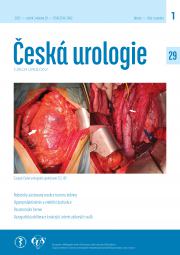

Czech urology, 2003 (vol. 7), issue 4
Laparoscopic and retroperitoneoscopic pyeloplasty
R. Kočvara, J. Sedláček, M.Vraný, J. Dvořáček, Z. Dítě
Ces Urol 2003, 7(4):6-10 | DOI: 10.48095/cccu2003021 
Aim of the study. To compare the treatment of stenosis of pyeloureteral junction (PUJ) by laparoscopic technique with open surgery and to draw attention to the problems associated with the implementation of this technique. Patients and methods. We indicated 12 patients to laparoscopic (LP) or retroperitoneoscopic (RP) pyeloplasty because of stenosis of PUJ from March 2001 do May 2003. Except for one female patient (58 years), all patients were 12,5 to 19,3 years (mean 16,4 years) of age. We compared them to a group of 13 patients in the age of 9 to 26 years (mean 13,4 years), operated on by transmuscular lumbotomic incission in...
Arteriovenous malformation of the kidney as a cause of massive haematuria in a haemophiliac
M. Broďák, A. Krajina, P. Navrátil, P. Kutílek
Ces Urol 2003, 7(4):11-13 | DOI: 10.48095/cccu2003022
Haemophilia, luckily a rare haematological disease, is a nightmare of all surgeons. We present a case report of massive haematuria in a patient with type A haemophilia, which occured after spontaneous passing of kidney stone. The cause - arteriovenous malformation - was diagnosed by angiography and was obliterated in a one-stage procedure.
Surgery of stricture, fistula and hypospadia of the urethra (own experience)
I. Novák, P. Kutílek, K. Baker, M. Louda
Ces Urol 2003, 7(4):14-19 | DOI: 10.48095/cccu2003023
The authors evaluate the results of surgery for urethral strictures (83), fistulae (5) and residual hypospadias after previous urethroplasty (2) in a group of 90 individuals operated on at the Department of Urology of Hradec Králové Faculty Hospital in the years 1996-2002. The strictures were 21x traumatogenic, 42x iatrogenic, 5x inflammatory and 14x of uncertain aethiology. All patients underwent previous unsuccessfull therapy. The authors state used techniques of the surgery: meatoplasty, urethroplasty with the use of a vascular skin flap, buccal graft or Snodgrass urethroplasty, resection urethroplasty, intubation urethroplasty and fistulorrhaphy....
Diagnosis and treatment of vesicosigmoideal fistulae after diverticulitides
P. Macek, Z. Veselský, P. Prošvic, P. Morávek, D. Šimkovič, L. Vykouřil
Ces Urol 2003, 7(4):20-23 | DOI: 10.48095/cccu2003024
The authors present the opportunities of diagnosis and treatment of vesicosigmoideal fistula by use of two patient cases, who vere operated on in cooperation of urological and surgical department of Faculty hospital in Hradec Králové in 2002. The pacients were investigated in the Urologic Department of Faculty Hospital Hradec Králové for repeated urinary infections or pneumaturia. Both patients had diverticulitis in their past history. The diagnosis was made by irigography, cystoscopy and cystography. The solution in both cases was excision of the fistula, together with resection of both colon sigmoideum and bladder. The patient were healed in a short time.
Squamous cell carcinoma of the urinary bladder
V. Soukup, M. Babjuk, P. Dundr, S. Polák, T. Hanuš, L. Zámečník, J. Dvořáček, C. Povýšil
Ces Urol 2003, 7(4):25-27 | DOI: 10.48095/cccu2003025
Pure squamous cell carcinoma of bladder (SCCB) is a rarely occuring tumour in western countries. The mode of treatment of squamous cell carcinoma is still not different from the treatment of transitional cell carcinoma of the bladder, in spite of the fact, that these two represent completely different entities. The natural course of the disease is characterised by tendency to local progression, which is the main cause of mortality as well. Metastasing is rare. Early radical cystectomy is recommended for treatment. Adjuvant or neoadjuvant actinotherapy is advisable, as recurrencies in the pelvic region are the most common form of disease progression....
Primary leiomyosarkoma of the kidney - a case report
P. Prošvic, P. Morávek, Z. Veselský, P. Macek, K. Odrážka, M. Podhola
Ces Urol 2003, 7(4):28-31 | DOI: 10.48095/cccu2003026
The authors describe the finding of a rare tumorous disease of the kidney - primary leiomyosarkoma. Pre-operative diagnosis done with the help of imaging methods was a carcinoma of the kidney in a 71-year old man. Right-sided transperitoneal nephrectomy was performed in February 2001. The tumor was localised in the parenchyma of the kidney. Histological diagnosis was leiomyosarcoma. Further investigations excluded other primary localisation or metastases. Two small metastases appeared on plain chest X-ray and were confirmed by spiral CT six and a half months after the surgery. The patient was referred to oncologist care, where he underwent six cycles...
Endometriosis of the urinary bladder
L. Rýdel, Z. Veselský, I. Kalousek, E. Šimáková
Ces Urol 2003, 7(4):32-34 | DOI: 10.48095/cccu2003027
Endometriosis is a benign disease characterised by ectopic location of endometrium, which preserves its anatomical structure and function. It affects mostly fertile women with maximum between 30-40 years of age. Its occurrence is usually associated with inner (less frequently with outer) reproductive organs (ovary, salpix, uterus) or anatomical structures of the true pelvis, adjacent to above mentioned location (parametrium, rectovaginal septum). Presence in scars, gastrointestinal tract or incidental finding in hernias containing a gut segment is rare. Finding in bladder is considered exceptional. Finding desribed by the authors (endometriosis isolated...
Urodynamic evaluation of the causes of incontinence of ileocaecal reservoires of the "Indiana pouch" type
M. Záleský, R. Zachoval, M. Urban, M. Lukeš, J. Heráček
Ces Urol 2003, 7(4):35-38 | DOI: 10.48095/cccu2003028
Heterotopic reservoire of the ?Indiana pouch? type, created by detubulisation of caecum and ascendens and draining of terminal ileum loop in abdominal wall is one of the option of continent derivation of urine. The authors try to evaluate the causes of incontinence of these reservoirs on the basis of urodynamic examination. Continence of heterotopic reservoirs depends on two factors: The pressue inside the reservoire and the closing pressure in the outflow part. 11 (39,3%) out of 28 patients were fully continent, 9 (32,1%) were satisfactorily continent and 8 (28,6%) pacients were incontinent. The group of patients suffering from incontinence...
Enteral nutrition in patients after cystectomy
M. Broďák, P. Kutílek, V. Dostálová, P. Dostál, J. Pacovský, Z. Vacek
Ces Urol 2003, 7(4):39-41 | DOI: 10.48095/cccu2003029
The aim of the study is to prove the advantages of enteral nutrition in patients after cystectomy compared with parenteral realimentation. We present a group of 30 patients, in whom cystectomy was done in the years 2001-2002. Enteral nutrition was given to 20 patients by jejunal catheter. In 10 patients conventional nutritional support was given parenterally, as ?All in one? infusion. Both groups were compared as for general health condition, healing of the surgical wound and reappearence of peristalsis. Laboratory values were compared in both groups. After comparing it is possible to say that enteral nutrition unlike parenteral nutrition has the...
Profesor MUDr. Jan Dvořáček, DrSc. šedesátníkem
R. Kočvara, T. Hanuš
Ces Urol 2003, 7(4):42