
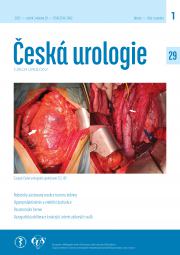

Czech urology, 2012 (vol. 16), issue 2
Spolupráca nikdy nechýbala
Ces Urol 2012, 16(2):81-82 
Failure of local treatment of prostate cancer
Milan Král, Vladimír Študent
Ces Urol 2012, 16(2):83-91 | DOI: 10.48095/cccu2012015
Terapeutic options with curative intent in prostate cancer include radical prostatectomy and radiotherapy. In many patients, rising PSA after completing the local therapy is detected and this is a marker of disease persistence. This PSA increase is often the only evidence of cancer relaps which usually preceeds clinical manifestation by months or years. Based on parameters such time to biochemical relaps, PSA kinetics, clinical or even patological features (staging, grading), the physician has to differ, whether local or systemic relaps occurs. Regarding to the type of relaps, further treatment is indicated.
Early salvage radiotherapy following radical prostatectomy indicated in patients with rising PSA levels below the conventional threshold of biochemical recurrence 0.2 ng/ml
Ladislav Jarolím, Štěpán Veselý, Marek Babjuk, Marek Schmidt, Pavel Dušek, Běla Malinová, Jana Prausová
Ces Urol 2012, 16(2):92-100 | DOI: 10.48095/cccu2012016
Aim:Prostate specific antigen (PSA) after radical prostatectomy (RP) assessed by ultrasensitive assay may help to detect biochemical recurrence (BR) at an early stage and thus probably more sensitive to salvage radiotherapy (SRT). We aimed to evaluate the efficacy of SRT in patients after RP with postoperative PSA increase below the levels 0.2 ng/ml and 0.2-0.3 ng/ml.Methods:The prospective analysis comprised 52 patients who underwent SRT for rising PSA after RP for localized prostate cancer. Rising PSA was defined as three consecutive rises of PSA measured by an ultrasensitive PSA assay (Immuli-te 2000 3rd Generation PSA,...
Possibilities of endoscopic management of retained incrusted ureteral stents
Petra Kočovská, Viktor Eret, Pavla Toufarová, Zdeněk Chudáček, Milan Hora
Ces Urol 2012, 16(2):101-107 | DOI: 10.48095/cccu2012013
Aim:On long-term kept ureteral stents are formed incrustations, which gradually become bigger and present a complicated situation even for an experienced endourologist. The aim of this article is to demonstrate our experience with endoscopic solutions of this problem.Material and method:Since 1/2010 to 2/2012 there have been 10 cases of incrustant stents solved with 6 patients, 4 women and 2 men, at the Department of Urology at University Hospital in Pilsen. In 4 cases the stent was inserted due to secondary megaureter, in 3 cases due to ureterolithiasis and in 3 cases due to hydronephrosis. The average time of keeping the...
Carcinoma rete testis
Katarína Slatinová, Zdeněk Salomon, Martin Labovský
Ces Urol 2012, 16(2):108-111 | DOI: 10.48095/cccu2012017
We report a case of nongerminal malignant tumour affecting the rete testis. This rare tumour can be misdiagnosed with other types of metastatic malignant tumours. Because of its aggressive biological behavior and resistance to chemotherapy and radiotherapy, tumor size at the time of diagnosis is the only proven factor in survival of patients with this disease.
Intestinal metaplasia of bladder mucosa in combination with Peutz Jeghers syndrome
Miroslav Hanuš, Michaela Matoušková, Ludmila Koldová
Ces Urol 2012, 16(2):112-116 | DOI: 10.48095/cccu2012018
Intestinal metaplasia of bladder mucosa in combination with Peutz Jeghers syndrome occurs relatively rarely. Some authors consider such metaplasia as a precancerosis. We report a patient suffering from both diagnosis and describe the next follow-up. Also the case is widely discussed.
Bilateral renal cell carcinoma treated by nephrectomy and nephron-sparing surgery using a single-stage procedure
Marie Hurtová, Miroslav Louda, Miroslava Romžová, Miloš Broďák
Ces Urol 2012, 16(2):117-120 | DOI: 10.48095/cccu2012019
About 1% out of all kidney tumors are bilateral at the time of diagnosis. To date surgical resection of the tumor represents the only available curative treatment. Large tumors require radical nephrectomy The nephron-sparing surgery is reserved for tumors which are smaller in size and peripheraly located. The nephrectomy of the solitary kidney condemns patients to the permanent dialysis with uncertain prospect of future renal transplantation. If possible, it is therefore imperative to use patial resection especially in solitary kidney. This case report describes a case of bilateral renal rumor treated by nephrectomy of giant tumor with tumor thrombus...
Hemorrhage into the scrotum as an initial sign of epididymal metastasis of prostate cancer
Daniel Macík, Eva Krejčí, Michal Staník, Jan Doležel
Ces Urol 2012, 16(2):121-124 | DOI: 10.48095/cccu2012012
We present a case of 81-year old patient with atypical course of prostate cancer. He has been treated for locally advanced prostate cancer in 1993. At that time he underwent explorative lymphadenectomy with simultaneous bilateral orchiectomy, followed by curative radiotherapy. He was free of biochemical or clinical progression until 2009 when sudden increase of PSA (8 ng/ml) was noticed, but no distant metastases were found. The patient was acutely seen at the emergency room for spontaneous development of haemoscrotum. He underwent revision of scrotum and epididymectomy with resection of the funiculus on the left side. Prostate cancer metastasis was...
Sentinel node lyphadenectomy of epidermoid carcinoma of the penis
Vít Pávek, Martin Drábek, Zdeněk Lavička
Ces Urol 2012, 16(2):125-128 | DOI: 10.48095/cccu2012020
A case report describing a technique for detection and resection of the sentinel node in a patient with epidermoid carcinoma of penis. European guidelines recommend examination of regional lymph nodes in patients withithout palpatable nodes for staging and grading purposes. Lymphadenectomy of the sentinel node represents a refinement of the staging of this cancer type. Decision to perform radical lymphadenectomy should be supported by histological confirmation of tumor infiltration of nodes.
Přehled novinek z 9. konference ESOU
Hamburk, 20. až 22. dubna 2012
Ces Urol 2012, 16(2):130-134
Zpráva o účasti rezidentů na výroční konferenci Slovenské urologické společnosti v Martině
Ces Urol 2012, 16(2):134-135
European urological scholarship programme (EUSP): reálná možnost pro českého urologa?
Ces Urol 2012, 16(2):135-136