
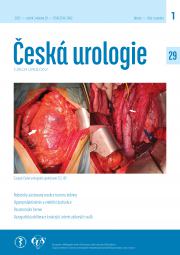

Czech urology, 2013 (vol. 17), issue 1
Editorial
Otakar Čapoun
Ces Urol 2013, 17(1):7-8 
Role of the urologist in the treatment of castration-resistant prostate cancer in the Czech Republic
Milan Hora, Marko Babjuk, Radim Kočvara
Ces Urol 2013, 17(1):11-17 | DOI: 10.48095/cccu2013002
The role of the urologist in the treatment of prostate cancer (PC) has been always crucial. Obviously working in close cooperation with physicians of other specialties, the urologist has always been managing the treatment. In certain stages of the disease radiotherapists played and plays important role. However, with the introduction of chemotherapy in prostate cancer treatment (castration-resistant stage) engagement of the clinical oncologists became more important.A locally advanced and metastatic PC requires care from the perspective local management of the disease (urination, upper urinary tract patency), symptoms (i.a. pain control), treatment...
Diagnosing adrenal disease - most significant clinical syndromes, biochemical testing and role of imaging methods
Filip Čtvrtlík, Miroslav Heřman, Igor Hartmann, Tomáš Tichý
Ces Urol 2013, 17(1):18-27 | DOI: 10.48095/cccu2013003
In this review article presents classification of the most significant clinical syndromes associated with adrenal hyperfunction. Clinical presentation, laboratory diagnosis and role of imaging techniques in the diagnosis of these syndromes are discussed in detail. A thorough description of the radiological presentation of the most frequent pathological findings on the adrenal glands is provided and some less common lesions are also briefly mentioned. Discussion of adrenal incidentalomas concludes the article.
Self-inserting foreign bodies in urogenital tract for the purpose of sexual stimulation
Petra Kočovská, Pavla Toufarová, Jiří Klečka, Zdeněk Chudáček, Milan Hora
Ces Urol 2013, 17(1):28-35 | DOI: 10.48095/cccu2013004
Aim:To evaluate methods of treatment of a foreign body inserted into the urogenital tract for the purpose of sexual stimulation.Methods:Ten patients were treated at the Department of Urology at University Hospital in Pilsen, between January 2006 and December 2012 (9 males on 1 female) for insertion if a foreign body into the urogenital tract. All patients had X-ray of small pelvis, sonographic examination of urinary bladder and abdominal CT.Results:The average age of all patients was 40.5 years (between 14 and 71 years of age). The hospitalization lasted 2.6 days in average (between 1 and 7 days). Two patients...
Testicular sperm aneuploidy in men with spinal cord injury
Jiří Heráček, Vladimír Sobotka, Miluše Vozdová, Jiří Rubeš, Michael Urban, Robert Grill
Ces Urol 2013, 17(1):36-41 | DOI: 10.48095/cccu2013005
Aim:The aim of the study was to compare the frequency of numerical abnormalities for chromosomes X, Y, 13, 15,16, 18, 21 and 22 in men with spinal cord injury to aneuplodia frequency results in normospermic control group of healthy volunteers using fluorescence in situ hybridization.Method:Eleven men (aged 21-41 years, average ± SEM: 36.2 ± 11.9) with anejaculation after transversal spinal cord lesions were included into study between 2010 and 2011. Testicular tissue samples with sperms were obtained by microsurgical retrieval and subsequently analysed by fluorescence in situ hybridization. The results were compared...
Examination of the sentinel lymph node, mapping of the prostatic primary lymphatic drainage and assessment benefit of this diagnostic procedure for staging of the prostate cancer
Michal Staník, Ivo Čapák, Daniel Macík, Karol Bolčák, Eva Lžičařová, Jiří Vašina, Martin Šustr, David Miklánek, Jan Doležel
Ces Urol 2013, 17(1):42-50 | DOI: 10.48095/cccu2013006
Aim:Sentinel lymph node (SLN) dissection replaces regional lymphadenectomy in early stages of many tumors. The objective of our study was to evaluate if the SLN dissection can improve staging of prostate cancer, define the regions of primary lymphatic drainage and correlate the staging accuracy of various templates of pelvic lymph node dissection (PLND).Material and methods:Fifty patients with estimated risk of lymphadenopathy above 5%, based on Briganti nomogram, were included in the study. On the day of surgery Tc-99m-labeled nanocolloid was injected into prostate and then the planar lymphoscintigraphy and single-photon...
Life-threatening bleeding into the peritoneal cavity due to spontaneous rupture of angiomyolipoma
Radek Sýkora, Martin Fabišovský, David Němec, Jiří Vašík, Jan Krhut
Ces Urol 2013, 17(1):51-54 | DOI: 10.48095/cccu2013007
We present a case report of a rare clinical manifestation of spontaneous rupture of an angiomyolipoma. Fourty eight year-old woman on antigoalution treatment with Warfarin* presented with haemoperitoneum. Bleeding into the retroperitoneum and peritoneal cavity due to spontaneous rupture of an angiomyolipoma was diagnosed. This situation led to the development of hemorhagic shock with a need for emergency surgical revision and right-sided nephrectomy We describe the diagnostic algorhytm, course of the disease and treatment outcomes.
Kidney morcellation after laparoscopic nephrectomy
Pavel Hanek, Tomáš Chmelenský, Jiří Zvěřina
Ces Urol 2013, 17(1):55-59 | DOI: 10.48095/cccu2013008
Laparoscopic nephrectomy is a minimally invasive procedure. In contrast with this characteristics, a relatively long incision is peformed at the end of the surgery to remove the specimen. Intracorporeal morcellation of the kidney allows for removed through a special port, avoiding a incision and painful scar. We have verified the possibility of removing a kidney after laparoscopic nephrectomy using a new method of plasmatic bipolar morcellation. The method is safe, fast and reliable. As with other types of morcellation it is only suitable for benign disease.
Komentář k článku Viktor Eret a kol "Jednoportová laparoskopie v urologii (Laparoendoscopic Single-Site Surgery, Less) - nová hranice miniinvazivity?"
Oto Köhler
Ces Urol 2013, 17(1):60-61
Novinky 10. konference ESOU
Řím, Itálie, 18.-20. ledna 2013
Otakar Čapoun
Ces Urol 2013, 17(1):62-66