
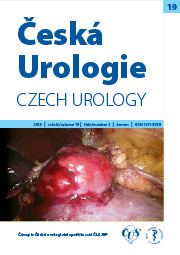
Czech urology, 2015 (vol. 19), issue 2
Editorial
Marek Babjuk
Ces Urol 2015, 19(2):101-102 
Video
Laparoscopic resection of kidney tumours
Milan Hora, Viktor Eret, Petr Stránský, Tomáš Ürge, Tomáš Pitra, Kristýna Kalusová, Jiří Ferda, Ondřej Hes
Ces Urol 2015, 19(2):103-105 | DOI: 10.48095/cccu2015021
Hora M, Eret V, Stránský P, Ürge T, Pitra T, Kalusová K, Ferda J, Hes O. Laparoscopic resection of kidney tumours. Introduction: This video presents our contemporary standard technique of laparoscopic resection (LR) of kidney tumours (KT), the method used most frequently by our group. Material: Between August 2004 and April 2015, we performed 274 LR. The surgical technique was continually developing along with the surgeons´ dexterity and usage of new technical accessories. At the same time, this surgical technique allowed for the treatment of a broader spectrum of KT, which are now managed using laparoscopic approach. This has gradually led...
Review article
New trends in renal angiomyolipomas therapy
Tomáš Ürge, Tomáš Pitra, Zdeněk Chudáček, Jiří Baxa, Petr Stránský, Viktor Eret, Ondřej Hes, Milan Hora
Ces Urol 2015, 19(2):106-117 | DOI: 10.48095/cccu2015015
Ürge T, Pitra T, Chudáček Z, Baxa J, Stránský P, Eret V, Hes O, Hora M. New trends in renal angiomyolipomas therapy. Renal angiomyolipoma (AML) is a benign mesenchymal tumor, which occurs sporadically or is associated with tuberous sclerosis complex (TSC). The overall prevalence of AML is 0.44 %, its incidence in women is 4 times higher than in men. Prevalence in the female population is thus 0.6 %, but male rates 0.28 %. Diagnosis is based on the presence of fat in the tumor. In most cases AML can be identified preoperatively. AML morphology is highly variable and in cases where fat is missing, preoperative diagnostic based on imaging...
Renal Ischemia in Partial Nephrectomy and Options for Its Influence
Petr Stránský, Milan Hora, Jan Hrbáček, Viktor Eret, Tomáš Ürge, Renáta Peteříková
Ces Urol 2015, 19(2):118-130 | DOI: 10.48095/cccu2015022
Stránský P, Hora M, Hrbáček J, Eret V, Ürge T, Peteříková R. Renal ischemia in partial nephrectomy and options for its influence Introduction: The objective of this literature review was to summarize clinical and experimental evidence of the renal responses to warm and cold ischemia. The study compared different surgical procedures and options for dealing with renal ischemia during partial nephrectomy. The article is a summary of the current literature data. Results: There are three main mechanisms of ischemic renal injury - vascular, persistent vasoconstriction with an abnormal endothelial cell compensatory response, and tubular obstruction,...
Physiotherapy in treating urinary incontinence in women
Jan Krhut, Romana Holaňová, Marcel Gärtner, David Míka
Ces Urol 2015, 19(2):131-136 | DOI: 10.48095/cccu2015016
Krhut J, Holaňová R, Gärtner M, Míka D. Physiotherapy in treating urinary incontinence in women. Urinary incontinence is one of the most common health problems especially in the female population. Globally hundreds of millions of people suffer from urinary incontinence. Over the last two decades, we have witnessed a growing interest in this field by both health care professionals and the general public. The main two forms of incon tinence are stress urinary incontinence and urge incontinence. Physiotherapy played in the treatment of incontinence always rather marginal role and traditionally was recommended only for the treatment of stress urinary...
Original paper
Radical prostatectomy with extended pelvic lymph node dissection: short-term oncological outcomes in patiens with nodal metastases. Is cure possible without systemic treatment?
Michal Staník, Jan Doležel, Ivo Čapák, Daniel Macík, Jiří Jarkovský, Eva Lžičařová, Marcela Vagundová, Martin Šustr, David Miklánek
Ces Urol 2015, 19(2):137-144 | DOI: 10.48095/cccu2015020
Staník M, Doležel J, Čapák I, Macík D, Jarkovský J, Lžičařová E, Vagundová M, Šustr M, Miklánek D. Radical prostatectomy with extended pelvic lymph node dissection: short-term oncological outcomes in patiens with nodal metastases. Is cure possible without systemic treatment? Aims: Lymph node metastasis is an unfavorable prognostic factor in prostate cancer. The benefit of pelvic lymph node dissection remains controversial. The aim of our study was to evaluate three-year oncological results and assess the potential of locoregional therapy consisting of radical prostatectomy (RP) with extended pelvic lymph node dissection (ePLND). We also evaluated the...
De novo urgency treatment of women after TOT procedure
Barbora Novotná, Jaroslav Ženíšek, Miloš Fiala
Ces Urol 2015, 19(2):145-148 | DOI: 10.48095/cccu2015024
Novotná B, Ženíšek J, Fiala M. De novo urgency treatment of women after TOT procedure. Objektive: Retrospective evaluation of the treatment de novo urgency with temporary medication. Methods: In a group of 73 female patients with stress incontinence, de novo urge syndrome appeared in eight (10.9 %) cases. Six of these women were treated with oral propiverine, one did not require any treatment for mild symptoms, and by one patient was switched from solifenacin to propiverine due to negative side effects. None of the patients suffered from urgency symtomps during the therapy. The duration of treatment ranged between 4-6 months. Results: Urge...
Case report
Liposarcoma and ganglioneuroma as primary retroperitoneal tumours
Miroslav Hruška, Petr Klézl, Petr Nencka, Jiří Klečka, Ivan Kolombo, Tomáš Jirásek, Petr Kujal, Robert Grill
Ces Urol 2015, 19(2):149-156 | DOI: 10.48095/cccu2015019
Hruška M, Klézl P, Nencka P, Klečka J, Kolombo I, Jirásek T, Kujal P, Grill R. Liposarcoma and ganglioneuroma as primary retroperitoneal tumours. We decribe a case reports of two patients with benign and malignant primary retroperitoneal tumors that presented with symptoms due to of the progressive tumor growth. One patient un derwent percutaneous biopsy with a suspicion of low grade liposarcoma. The patient was designated for surgical intervention. The recurrence of the tumor occurs in seventh months post-surgery, at which point the tumor was excised and followed by postoperative chemotherapy. Upon completion the patient underwent an additional...
Asynchronous bilateral seminoma based on intratubular germ cell neoplasia unclassified type
Jakub Musil, Daniel Bulíř, Jan Jandejsek
Ces Urol 2015, 19(2):157-162 | DOI: 10.48095/cccu2015018
Musil J, Bulíř D, Jandejsek J. Asynchronous bilateral seminoma based on intratubular germ cell neoplasia unclassified type. Objective: We are presenting a case report of young man who developed an asynchronous bilateral seminoma based on an intratubular germ cell neoplasia of unclassified type (IGCNU). Case report: A patient, with history of a stage I seminoma of the left testis, based on an IGCNU of the left testis, after a radical orchidectomy and adjuvant radiotherapy, was referred to the urology clinic with a suspected tumor of the right testis. A testicular biopsy was made and the histological examination...
Tumor glans as a clinical manifestation of plasmablastic lymphoma
Daniel Bulíř, Jan Jandejsek, Vojtěch Láska, Lukáš Wagenknecht, Jakub Musil
Ces Urol 2015, 19(2):163-167 | DOI: 10.48095/cccu2015017
Bulíř D, Jandejsek J, Láska V, Wagenknecht L, Musil J. Tumor glans as a clinical manifestation of plasmablastic lymphoma. We report a case of an elderly man who has presented with tumorous affection involving the uncircumcised penile glans and prepuce. Primary clinical examination gave strong suspicion for primary carcinoma of penis, therefore a suprapubic cystostomy and partial amputation of penis were performed. Histopatological examination revealed uncommon diagnosis of plasmablastic lymphoma involving glans penis and prepuce. The vast majority of penile tumours are squamous cell carcinomas, primary malignant lymphoma of penis...
Information
30. výroční konference EAU v Madridu
Jan Šarapatka
Ces Urol 2015, 19(2):168-169