
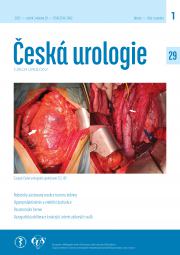

Czech urology, 2014 (vol. 18), issue 2
Vážené kolegyně, Vážení kolegové,
Ces Urol 2014, 18(2):83 
Intravesical therapy of urinary bladder tumours
Viktor Soukup, Otakar Čapoun, Michael Pešl, Zuzana Feherová, Tomáš Hanuš
Ces Urol 2014, 18(2):85-93 | DOI: 10.48095/cccu2014020
According to current guidelines, intravesical treatment should be offered to every patient with non-muscle invasive bladder cancer. The type of intravesical therapy should be based on the risk of recurrence and progression. In patients with low risk Ta tumours, a single intravesical instillation, immediately following resection, is recommended. A full course of intravesical chemotherapy or BCG instillation is recommended in all remaining risk groups. In patients with intermediate-risk tumours, one immediate post-resection administration of intravescial chemotherapy should be followed by one year of full course BCG treatment, or additional intravesical...
Classification of the penile intraepithelial neoplasias preceding invasive squamous cell carcinomas and their analogy with precancerous lesions of vulvar squamous cell carcinoma
Michal Michal, Ondřej Hes, Denisa Kacerovská, Milan Hora, Leopold Rotter, Marian Švajdler, Dmitrij Kazakov
Ces Urol 2014, 18(2):94-100 | DOI: 10.48095/cccu2014021
We present a review of the classification of penile intraepithelial neoplasias preceding invasive squamous cell carcinomas. Since these lesions are analogous to vulvar lesions, we present classification of vulvar lesions, and discuss the analogy between vulvar and penile intraepithelial neoplasia classification. Terms such as Bowenoid papulosis, Bowenoid dermatosis, erythroplasia of Queyrat, leukoplakia, and giant condyloma of Buschke-Lowenstein should not be used in diagnostic pathology.
Predictive parameters of metastatic renal cell cancer
Roman Sobotka, Otakar Čapoun, Viktor Soukup, Tomáš Hanuš
Ces Urol 2014, 18(2):101-111 | DOI: 10.48095/cccu2014022
The goal of this study was to define clinical and laboratory parameters for metastatic renal cell carcinoma (RCC) in patients indicated for surgery.A total of 218 patients underwent surgery for kidney tumors from May 2008 to February 2012. Age, sex, smoking history, body mass index, clinical symptoms, and selected laboratory and perioperative parameters were recorded for all patients. Histological examination included the type and tumor size, grade, and other histological findings. The significance of each parameter was evaluated using a nonparametric ANOVA (Wilcoxon test). The relative risk was assessed using a regression model to generalize the...
The role of pulmonary metastasectomy in the treatment of disseminated clear renal cell carcinoma
Josef Vodička, Vladimír Špidlen, Jakub Fichtl, Petr Mukenšnabl, Lucie Šefrhansová, Milena Roušarová, Milan Hora
Ces Urol 2014, 18(2):112-118 | DOI: 10.48095/cccu2014023
Introduction:At the time of diagnosis, up to one third of patients with clear renal cell carcinoma have a disseminated disease, and half of patients with the localized disease will progress in the future. Dissemination into the lungs develops most frequently.Purpose:Retrospective analysis of a group of patients undergoing surgery due to pulmonary metas-tases of clear renal cell carcinoma over a period of twelve years.Material and methods:Between 2001 and 2012, 21 patients, including 14 males, with a mean age of 65.7 years, underwent surgery at the authors' department. Those patients who had undergone a radical...
Endoscopic extraperitoneal radical prostatectomy and its complications - personal experience from the first 300 procedures
Květoslav Novák, Petr Macek, Michael Vraný, Michael Pešl, Zuzana Valová, Jan Dvořáček, Tomáš Hanuš
Ces Urol 2014, 18(2):119-127 | DOI: 10.48095/cccu2014024
Goal of study:The goal of the study was to evaluate complications in a group of patients with prostate carcinoma (PC) surgically treated by endoscopic extraperitoneal radical prostatectomy (EERP) at our department.Method:We performed this type of surgery exclusively using the extraperitoneal approach as an an-terograde procedure. Five chronologically arranged groups of patients were compared (A-36, B-34, C-70, D-77, E-83).Results:From 2/2008 to 6/2013 we performed 300 EERP in patients with a BMI up to 45, age 48-77 (0 64) years, PSA 0.71-34.9 (0 8,1) ng/ml. Specimen weight was 15-185 (0 56) g. Average duration...
Percutaneous nephrolithotripsy in Galdakao-modified supine position
Milan Král, Barbora Látalová, Michal Grepl, František Hruška, Filip Čtvrtlík, Zbyněk Tüdös, Pavel Rajmon, Vladimír Študent
Ces Urol 2014, 18(2):128-133 | DOI: 10.48095/cccu2014016
Aim: To present our personal experience with Galdakao modified supine position in percutaneous nephrolithotripsy and in combined antegrade and retrograde endoscopic procedures.Methods:Between May 2013 to January 2014 we performed 20 percutaneous surgeries in modified supine position (percutaneous nephrostomy due to renal obstruction in 6 cases and percutaneous nephrolithotomy in 14 cases). One case was performed using the combined intrarenal technique.Results:Average surgery time was 113 minutes and stone size was 310 mm2. In 8 cases there were multiple or staghorn stones. Average hospital stay following...
Aneurysmal cyst of the adrenal gland
Tomáš Hyndrák, Milan Hora, Zdeněk Chudáček, Ondřej Hes
Ces Urol 2014, 18(2):134-137 | DOI: 10.48095/cccu2014025
Aim:Case report of rare cystic tumor of the adrenal gland.Case report:A 40-year old woman was examined for a dull pain in her loins. Cystoid adrenal incidentalome was described on CT and MRI images. Based on the results of endocrinologic examination, the decision to perform an adrenalectomy was made. The patient underwent single-port laparoscopic (LESS) adrenalectomy. The final histology described a completely benign lesion - aneurysmal cyst of adrenal gland - cystic lesion of the vascular origin that was in transitional form between cyst and pseudocyst.Conclusion:Origin of cystic lesions is variable. Patients...
Burned-out tumour of the testis with metastasis to the retroperitoneal lymph node
Karol Kajo, Michal Kajo, Katarína Macháleková, Július Palaj, Iveta Mečiarová, Peter Zuzák, Emil Tvrdík
Ces Urol 2014, 18(2):138-143 | DOI: 10.48095/cccu2014017
The term "burned-out tumour" refers to a rare clinical entity that represents a complete spontaneous regression of previously untreated testicular cancer with metastases in the retroperitoneum, mediastinum, lymph nodes, lung or liver. We describe the case of a 55-year-old patient with pain in the right lumbar region, in which the CT scan disclosed a tumour mass in the retroperitoneum (sized 70 x 55 x 90 mm), and ultrasonography revealed structural changes in the lower pole of the right testicle. First, the patient underwent a right-sided orchiectomy with histological finding of a scar in the testicle without distinct tumour changes, followed by radical...
The case of enormous benigne prostate hyperplasia
Jiří Klečka, Petr Klézl, Petr Nencka, Věra Mašková, Robert Grill
Ces Urol 2014, 18(2):144-149 | DOI: 10.48095/cccu2014026
The authors present a case report of a 72-year old patient, which had an open prostatectomy using Frayer-Fuller procedure for complicated benign prostatic hyperplasia, reaching monstrous proportions, 930 grams. So far, the largest published case of adenoma was from India in March 2010, when Dr. Rajendra Punjabim removed an adenoma weighing 650 grams. Our case is both a medical rarity, and also a world rarity, aspiring for entry into the Guinness Book of Records.
Asynchronous solitary metastasis of clear cell carcinoma 7 years after nephrectomy manifesting as Horner syndrome
Zdeněk Polák, Pavel Koscielnik, Radek Sýkora, Mika David, Jan Krhut
Ces Urol 2014, 18(2):150-153 | DOI: 10.48095/cccu2014018
Renal cell carcinoma occurs most frequently in the sixth decade of life. Males are affected about twice as often as women. Renal carcinoma accounts for about 3% of malignant tumors in adults. Distant metastases may occur even after several years of primary localized disease. Most kidney carcinomas metastasize into the lungs, lymphatic nodes and liver. In this case report we present an organ confined kidney carcinoma that metastasized after 7 years into the left carotid bifurcation and was manifested as posttraumatic Horner Syndrome. This manifestation has not yet been reported in the literature.
Konference dětských urologů, nefrologů a pediatrů
Kurdějov, 29. až 31. května 2014
Ces Urol 2014, 18(2):155-176
Karcinom prostaty - novinky z konference ascogu
Ces Urol 2014, 18(2):177-180